
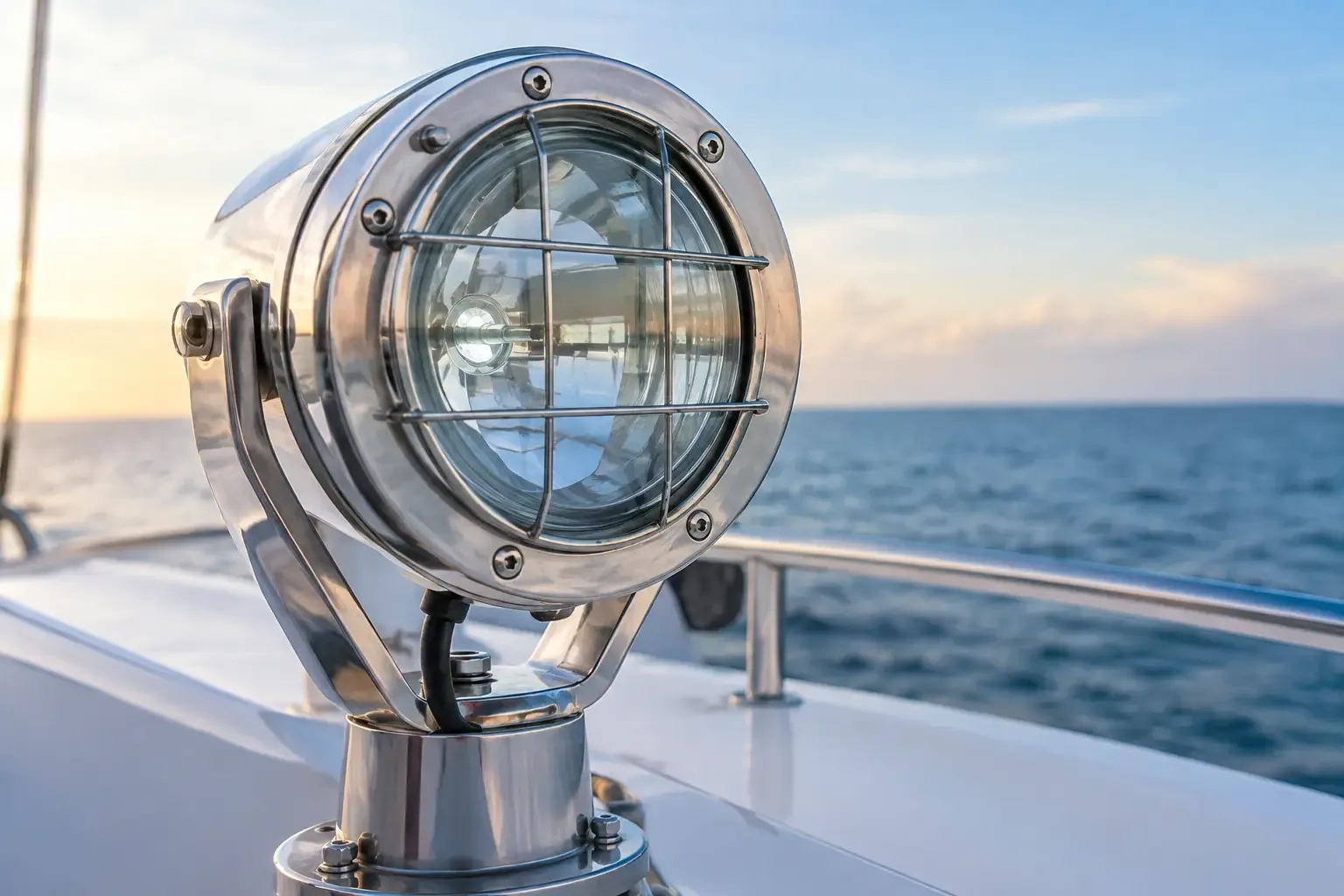
Salt deposits do not need to be visibly heavy to shorten a luminaire's service life. Moisture films form around hardware, cable entries, lens frames, and dissimilar metal joints, turning a routine marine lighting installation into a corrosion cell. This marine lighting corrosion protection guide focuses on the fixture details that protect uptime on vessels, docks, shipyards, offshore platforms, and coastal industrial facilities.
We have found that buyers get better results when they specify the whole installed assembly, not just a fixture's housing material. A marine-rated enclosure can still fail early when its mounting bracket, conduit fitting, fasteners, or field-drilled entry is not compatible with saltwater exposure. For project support, Maes Lighting evaluates the environmental conditions, compliance requirements, and documentation needed before equipment reaches the jobsite.
Start With the Actual Corrosive Exposure
“Marine” is not one operating condition. An enclosed machinery space may experience humidity, oil mist, vibration, and intermittent salt contamination. An exterior deck fixture can face direct spray, ultraviolet exposure, standing water, impact, and daily wet-dry cycling. A shore-side loading terminal may see salt air plus chemical vapors from process equipment.
The distance from open water matters, but it is not the only factor. Wind direction, washdown frequency, sheltered areas that stay damp, and nearby stainless or aluminum structures all affect corrosion behavior. Ask where chlorides collect and whether crews use alkaline, acidic, or chlorine-based cleaners. Those answers influence the appropriate metal, coating system, lens gasket, cable gland, and mounting method.
For offshore and coastal installations, do not treat a general-purpose wet-location rating as evidence of marine durability. It addresses a different question: whether water can enter the enclosure under a defined test condition. Long-term resistance to salt spray and galvanic corrosion requires a material and installation review.
Choose the Housing Material for the Duty
Marine fixtures commonly use marine-grade aluminum with a corrosion-resistant powder coat, stainless steel, or specialty polymeric materials. Each can be appropriate, but none is automatically correct for every location.
Powder-coated aluminum provides a practical balance of weight, thermal performance, and cost for many deck, pier, and exterior building applications. Its weakness is coating damage. A scratch that exposes bare aluminum near a stainless fastener or steel bracket can concentrate corrosion at the defect. Specify a coating suitable for severe exterior service, and inspect fixtures after shipment and installation for chips, cut edges, and handling damage.
Type 316 stainless steel generally provides better chloride resistance than Type 304 stainless steel and is often the stronger choice for exposed hardware, enclosures, and mounting components near salt spray. It still requires maintenance. Deposited salt, trapped moisture, and contamination from carbon-steel tools can create staining and localized corrosion. Stainless is not maintenance-free, particularly in continuously wet crevices.
Polymeric housings avoid galvanic interaction and can resist many chemicals, but they must be evaluated for ultraviolet stability, impact resistance, heat, and compatibility with the cleaning agents used onsite. For high-output LED fixtures, thermal management also matters. A material that resists corrosion but retains too much heat can reduce LED life.
Avoid Galvanic Couples at the Mounting Point
Galvanic corrosion occurs when dissimilar metals are electrically connected in an electrolyte such as saltwater. The less noble metal becomes the sacrificial side of the pair. The fixture body may look intact while the bracket, bolts, washers, or mounting surface degrade first.
Use compatible hardware wherever practical. Where mixed metals cannot be avoided, isolate them with nonconductive washers, sleeves, gaskets, or approved barrier materials. This must be done without compromising the equipment grounding path. The electrical contractor and project engineer should confirm grounding continuity rather than assuming an isolation washer solves every issue.
Fastener selection deserves the same attention as the luminaire. A 316 stainless enclosure secured with low-grade plated hardware is not a marine corrosion strategy. Specify fasteners, lock washers, clamps, and cable support hardware as part of the lighting package.
Seal the Paths Water Actually Uses
Ingress protection ratings are valuable selection data, but they need to be read correctly. IP66 indicates protection against powerful water jets, while IP67 adds temporary immersion performance under test conditions. IP69K is intended for high-pressure, high-temperature washdown conditions. These ratings are defined through IEC 60529 and related test methods, but they do not by themselves certify a fixture for every marine service condition.
Water rarely enters only through the lens. It reaches failures through improperly tightened cable glands, unsealed unused entries, cracked conduit seals, damaged gaskets, and field modifications. Specify the correct thread form and listed fittings for the enclosure. A gland suitable for a round flexible cable may not seal a different cable diameter or jacket construction.
Condensation is another concern. A fully sealed fixture can still experience pressure changes as it heats and cools. In conditions with persistent humidity, a properly engineered pressure-equalization vent may help reduce moisture stress. It must be part of the fixture's tested design, not an unapproved hole added in the field.
Protect Coatings, Lenses, and Optical Performance
Corrosion protection is also a light-output issue. A hazed lens, stained reflector, or corroded heat sink reduces useful illumination long before a fixture stops operating. On a dock, gangway, or vessel work area, lower output can affect safe task visibility and create unplanned maintenance work.
Specify lens materials for the exposure. Tempered glass withstands many chemicals and resists ultraviolet degradation but can be vulnerable to impact in some service areas. Polycarbonate provides strong impact resistance, yet its chemical compatibility and long-term weathering should be reviewed. If cleaners are used frequently, obtain compatibility information for the lens, gasket, finish, and cable jacket rather than approving the fixture based only on its enclosure rating.
Salt buildup should be removed before it hardens into a contaminating film. Avoid abrasive pads or steel wool that can damage coatings and embed ferrous particles in stainless steel. Cleaning instructions should match the fixture manufacturer’s guidance and the facility’s environmental procedures.
Check Listings and Marine-Specific Documentation
For equipment installed on marine vessels, the applicable listing and construction standard can differ from shore-based industrial lighting. UL 1598A covers marine vessel luminaires and fittings. UL Solutions documentation should identify what the product was evaluated for, rather than relying on a broad claim that it is “marine grade.” Intertek and other Nationally Recognized Testing Laboratories may also provide product certification documentation where applicable.
For shore-side facilities, the governing requirements may include the National Electrical Code, local authority requirements, wet-location suitability, and hazardous-location classifications. A fuel transfer point or enclosed area with flammable vapors may require explosion-proof lighting evaluated for the specific Class, Division, Group, or Zone. Corrosion resistance does not replace hazardous-location compliance, and a hazardous-location listing does not eliminate the need for corrosion protection.
Request the datasheet, certification file, temperature ratings, ingress rating, photometric file, mounting details, and installation instructions during submittal review. A credible specification identifies the exposure and the performance requirement instead of relying on vague phrases such as “heavy-duty marine fixture.”
Install Without Undoing the Fixture Design
Many premature failures begin at installation. Do not drill extra drain holes, replace listed entries with unverified fittings, or remove factory gaskets to make a mounting arrangement work. Those changes can void ratings and create direct corrosion paths.
Route conductors so water does not run into glands and junction points. Use drip loops where appropriate, support cables to limit vibration load, and keep mounting orientations consistent with the manufacturer’s drainage design. On vessels and structures subject to movement, confirm that brackets and conduit connections accommodate vibration without chafing insulation or loosening fasteners.
Torque is not a minor detail. Under-tightening can compromise gasketing, while over-tightening can deform seals, strip threads, or crack polymeric components. Maintenance teams should have the installation instructions and torque values in the turnover package, especially where multiple contractors install the same fixture type.
Build Corrosion Checks Into Preventive Maintenance
A practical inspection program is usually less expensive than emergency replacement at height or during a shutdown. Inspection frequency depends on direct exposure, washdown cycles, operating temperature, and the consequence of a lighting outage. High-spray deck locations deserve closer attention than sheltered interior spaces.
During inspections, look for coating blisters, chipped finishes, white aluminum oxidation, rust staining around fasteners, gasket compression loss, lens haze, water inside the enclosure, loose glands, and discoloration at electrical connections. Record patterns by location. Repeated damage on one side of a facility may reveal prevailing spray, an incompatible cleaning chemical, or a mounting design problem rather than a fixture defect.
If corrosion is discovered, determine the mechanism before replacing equipment. Replacing a failed luminaire with an identical model without correcting a galvanic connection, damaged conduit entry, or cleaner incompatibility often repeats the same failure cycle.
The right marine lighting choice is rarely the most expensive housing or the highest IP number in isolation. It is the fixture and installation system that match the site’s salt exposure, washdown practice, electrical classification, vibration, maintenance access, and required documentation. Address those conditions before procurement, and the lighting system is far more likely to remain safe, compliant, and serviceable when the environment is doing its worst.