
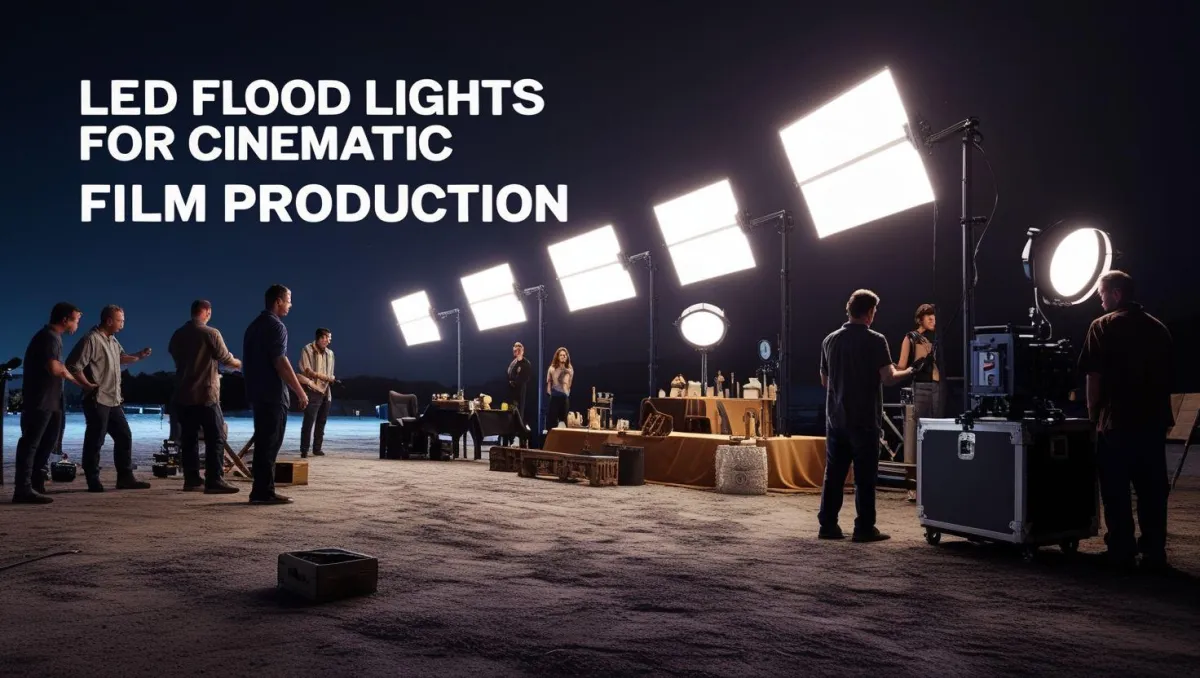
LED flood lights have become a cornerstone of cinematic film production, offering bright, versatile, and energy-efficient lighting for movie scenes, from dramatic night shoots to expansive outdoor sets. Their adaptability and performance make them ideal for creating stunning visuals while maintaining cost-effectiveness. At Maes Lighting, we provide high-quality LED flood lights designed to meet the demands of film and television production. This guide explores the role of LED flood lights in movie scenes, key selection factors, and tips for achieving cinematic excellence.
Why LED Flood Lights Are Essential for Film Production
Film production requires lighting that delivers consistent brightness, accurate color rendering, and flexibility to adapt to various shooting conditions. LED flood lights excel in these areas, outperforming traditional halogen or HMI lights. According to the American Society of Cinematographers, LED technology has revolutionized film lighting by offering energy efficiency and precise control. Our cinematic LED lighting ensures filmmakers achieve professional-grade results.
Limitations of Traditional Film Lighting
Traditional lighting, such as halogen or HMI, poses challenges:
High energy consumption increases production costs.
Excessive heat output complicates set management.
Bulky designs limit portability and setup flexibility.
Learn more about these limitations at Lighting Design Online.
Benefits of LED Flood Lights in Movie Scenes
LED flood lights offer distinct advantages for cinematic applications:
High Brightness and Coverage
With lumen outputs of 20,000–50,000+, LED flood lights provide powerful, wide-angle illumination for large sets, such as cityscapes or outdoor battle scenes. Our high-lumen LED flood lights deliver exceptional brightness.
Accurate Color Rendering
A Color Rendering Index (CRI) of 90+ ensures true-to-life colors, critical for capturing realistic skin tones and vibrant set designs. LEDs with tunable color temperatures (2700K–6500K) allow cinematographers to match any lighting condition. Explore color rendering benefits at Lightology. Our high-CRI LED fixtures ensure cinematic precision.
Energy Efficiency and Cost Savings
LED flood lights consume up to 60% less energy than traditional lights and last over 50,000 hours, reducing power and maintenance costs on long shoots. Our energy-efficient LEDs support budget-conscious productions. Learn about energy savings at Energy Star.
Portability and Versatility
Compact and lightweight, LED flood lights are easy to transport and adjust, making them ideal for on-location shoots. Dimmable and wireless options enhance creative control. Our portable lighting solutions offer flexibility for filmmakers.
Low Heat Emission
LEDs emit minimal heat, improving actor comfort and reducing the need for additional cooling on set. This also lowers energy consumption for climate control. Check out heat reduction benefits at PFS Lighting.
How Do CRI and Flicker Affect LED Flood Lights on Camera?
A Color Rendering Index number is the figure most flood-light spec sheets advertise, but CRI was never designed to predict how a light source behaves once it passes through a camera sensor and display chain rather than the naked eye. The Television Lighting Consistency Index (TLCI), developed by the European Broadcasting Union and published as EBU Tech 3355, replaces CRI's human "standard observer" with a modeled television camera and display, scoring only the color behavior that actually reaches an imaging sensor. Broadcast and production crews generally treat a TLCI score in the high 80s to 90s as ready for use without color correction, and a fixture can read acceptably on CRI while still shifting color noticeably once captured — which is why cinematographers increasingly ask for a TLCI figure or a camera-verified test rather than a CRI number alone before committing a fixture to key or hero lighting.
Documented CRI Across the Maes Flood Lineup
Within the Maes flood and area lighting lineup, a CRI figure is published for two of the three flood families; the third does not carry one in the source reviewed for this guide:
| Family | Documented CRI | CCT options | Output range |
|---|---|---|---|
| LS-FL Tunable | > 72 | 3000 K, 4000 K, 5000 K, field-switchable | 2,025–20,250 lm, 15–150 W |
| AST-FL-13 | > 72 | 5700 K, fixed | 36,720–45,900 lm, 240–300 W |
| RT Series | Not specified in source; confirm directly | 2800–7500 K, ordered per model | 16,000–240,000 lm, 100–1500 W |
A CRI in the low-to-mid 70s is a general industrial and area-lighting specification, not a color-critical one — professional cinema and broadcast work typically calls for CRI 90+ or a TLCI in the high 80s or above on any fixture lighting a subject's face or a color-sensitive set piece. None of the three flood families were built or marketed by Maes as color-critical cinema instruments; the LS-FL Tunable's power-and-CCT-switchable design and the RT Series' high lumen output make both well suited to large-area night-exterior coverage, background fill, and practical set lighting, where coverage and raw output matter more than a CRI or TLCI score. For any fixture lighting a subject directly, request a TLCI figure or run a camera test on the actual sensor before committing to it.
Why LED Flood Lights Can Flicker on Camera
The U.S. Department of Energy has researched temporal light modulation — the technical term for flicker — since 2009, and its flicker research program explains why LEDs are more prone to visible flicker than older lighting technology: an LED has almost no thermal or phosphor persistence, so it responds to its driver's electrical signal nearly instantly, with no afterglow to smooth out rapid changes in current. Most dimmable LED drivers control brightness with pulse-width modulation (PWM), switching the LED fully on and off rather than reducing current continuously; the human eye averages a high enough PWM rate into what looks like a steady glow, but a camera sensor does not — it records whatever the LED's actual on or off state is during each frame's specific exposure window. DOE's guidance points to high-frequency PWM, generally above 12,000 Hz, or non-PWM driver designs as the ways manufacturers keep flicker below the point where it becomes visible.
Why This Matters More on Camera Than to the Eye on Set
A flicker rate invisible to someone standing on set can still produce visible banding or exposure pulsing on camera, because a camera's shutter captures a specific, short exposure window many times per second rather than integrating light continuously the way the human eye does. Whether a given driver's flicker becomes visible on camera depends on the interaction between its PWM frequency and the camera's frame rate and shutter angle — a combination that changes with every camera and setting, which is why productions test a specific fixture on the specific camera package intended for the shoot rather than relying on a driver-frequency spec alone.
Maes' published spec sheets for the LS-FL Tunable, RT Series, and AST-FL-13 flood families do not state a driver PWM frequency or a percent-flicker figure in the source reviewed for this guide. For any shoot where flicker-free performance is a hard requirement — high frame rate work, slow motion, or any scene where the flood light sits directly in frame — confirm driver flicker performance directly with Maes or test the specific fixture against the camera and frame rate the production intends to use, rather than assuming flicker-free operation from the LED rating alone.
Key Factors for Choosing LED Flood Lights for Film Production
Selecting the right LED flood lights for movie scenes involves evaluating these factors:
Lumen Output and Beam Angle
Choose high-lumen fixtures (20,000+ lumens) for large-scale scenes and adjustable beam angles (15°–120°) for precise lighting control. Our LED flood lights offer customizable options.
Color Temperature and CRI
Opt for tunable LEDs (2700K–6500K) with a CRI of 90+ to achieve versatile and accurate lighting. Our high-CRI LED fixtures ensure vibrant visuals.
Durability and Weather Resistance
For outdoor shoots, select IP65-rated or higher fixtures to withstand rain, dust, and extreme conditions. Our durable LED flood lights are built for rugged environments. Learn about IP ratings at LED Lighting Supply.
Dimming and Control Features
Dimmable LEDs with wireless or DMX control allow cinematographers to fine-tune intensity and effects. Our
support advanced control systems.
Portability and Mounting Options
Lightweight fixtures with versatile mounting options (e.g., tripods, clamps) simplify setup on dynamic film sets. Our portable LED flood lights enhance mobility.
Applications of LED Flood Lights in Movie Scenes
LED flood lights are used in various cinematic scenarios:
Night Shoots: High-lumen flood lights illuminate large outdoor scenes, like car chases or battle sequences.
Studio Sets: Tunable LEDs create mood lighting for dramatic close-ups or interviews.
Location Shoots: Portable, weather-resistant flood lights adapt to remote environments.
Special Effects: Dimmable LEDs enhance dynamic lighting for explosions or transitions.
Our cinematic LED lighting supports these diverse applications.
Best Practices for Using LED Flood Lights in Film Production
To achieve cinematic excellence, follow these best practices:
Plan Lighting Design
Collaborate with cinematographers to create a lighting plan that aligns with the director’s vision. Our lighting consultation services provide expert guidance.
Use Diffusers and Filters
Soften or color-correct light with diffusers or gels to achieve the desired mood. Our customizable lighting solutions support these accessories.
Test Equipment Before Shooting
Test flood lights for color accuracy, dimming range, and compatibility with control systems to avoid delays. Our cinematic lighting guide offers setup tips.
Maintain Fixtures Regularly
Clean lenses and inspect fixtures to ensure optimal performance during long shoots. Learn more at Maes Lighting’s maintenance blog.
Ensure Safe Installation
Hire certified electricians to secure fixtures and comply with NEC standards for safe operation.
Why Choose Maes Lighting for Cinematic Lighting?
At Maes Lighting, we offer industry-leading LED flood lights designed for cinematic film production. Our fixtures deliver high brightness, accurate color rendering, and energy efficiency, meeting the demands of professional filmmakers. With durable, portable, and smart options, we help you create stunning movie scenes.
Ready to elevate your film production with LED flood lights? Contact us at or visit Maes Lighting for a free quote. Explore our cinematic LED lighting today.